


Exercise and Brain Health: Can Targeted Nutrients Amplify the Brain’s Natural Defense Systems?
From a discussion with ChatGPT: Discuss aerobic /resistance exercise and their brain health promoting molecular pathways and the potential of their synergism with the mechanistic modulation of these pathways by the pharmacologic action of combinations of huperzine A ,genistein, VitaminD and caffeine for women and huperzine A, DHEA, Vitamin D and caffeine in men.
Aerobic and Resistance Exercise as Molecular Regulators of Brain Health: Potential Synergism with Targeted Pharmacologic Combinations
The effects of exercise on brain aging are mediated through highly conserved molecular signaling pathways that regulate neuroplasticity, neurogenesis, inflammation, mitochondrial function, cerebral blood flow, and protein homeostasis. Many of these pathways overlap with those influenced by compounds such as huperzine A, genistein, vitamin D, caffeine, and DHEA, creating a biologically plausible framework for synergistic intervention to preserve cognitive reserve and reduce the risk of age-related cognitive decline and Alzheimer’s disease (AD).
It should be emphasized that while exercise has robust clinical evidence supporting cognitive benefits, evidence for the proposed pharmacologic combinations remains largely preclinical or based on individual compounds rather than randomized trials of the combinations.
Exercise as a Master Regulator of Brain Health
Aerobic Exercise
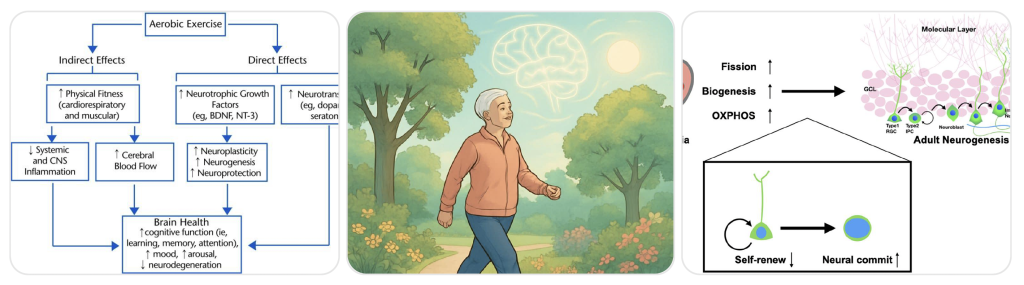
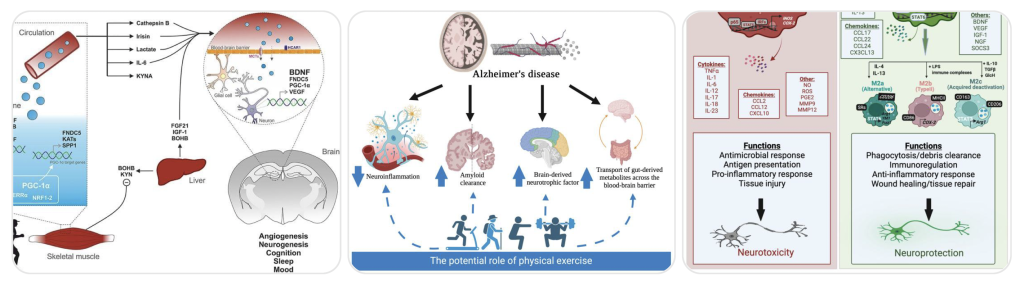
Aerobic exercise induces systemic metabolic adaptations that communicate with the brain through circulating myokines, hepatokines, adipokines, and vascular mediators.
Major molecular targets include:
| Pathway | Effect |
| BDNF ↑ | Synaptogenesis |
| IGF-1 ↑ | Neurogenesis |
| VEGF ↑ | Angiogenesis |
| PGC-1α ↑ | Mitochondrial biogenesis |
| FNDC5/Irisin ↑ | Hippocampal plasticity |
| AMPK activation | Energy sensing |
| SIRT1 activation | Longevity signaling |
| Nrf2 activation | Antioxidant defense |
| eNOS activation | Cerebral perfusion |
| Autophagy ↑ | Protein clearance |
| Microglia M2 polarization | Anti-inflammatory |
| IL-10 ↑ | Resolution of inflammation |
| IL-6 (exercise-induced transient) | Myokine signaling rather than chronic inflammation |
Resistance Exercise
Principal mediators include:
- IGF-1
- Growth hormone
- Testosterone (men)
- DHEA sulfate
- mechano-growth factor
- Akt signaling
- mTOR regulation
- satellite cell activation
- osteocalcin release
- myokines including IL-15
These promote:
- synaptic maintenance
- hippocampal integrity
- white matter preservation
- executive function
- improved insulin sensitivity
- mitochondrial quality control
Resistance training appears particularly effective in preserving frontal lobe function duringaging.
Common Brain-Protective Pathways Activated by Exercise
Exercise positively regulates:
- BDNF
- CREB
- TrkB signaling
- PI3K/Akt
- MAPK
- Wnt/β-catenin
- SIRT1
- PGC-1α
- Nrf2
- FOXO
- autophagy
- glymphatic clearance
- mitochondrial biogenesis
- insulin receptor signaling
- glucose transporter (GLUT4)
- cerebral angiogenesis
while suppressing
- NF-κB
- NLRP3 inflammasome
- TNF-α
- IL-1β
- chronic IL-6
- oxidative stress
- reactive oxygen species
- apoptotic signaling
Alzheimer’s-Relevant Targets Modified by Exercise
Exercise decreases:
- β-secretase (BACE1)
- amyloid production
- tau hyperphosphorylation
- GSK3β activity
- neuroinflammation
- oxidative injury
Exercise increases:
- ADAM10 α-secretase activity
- neprilysin
- insulin degrading enzyme (IDE)
- autophagic clearance
- synaptic density
- hippocampal neurogenesis
Synergism with Huperzine A
Huperzine A acts beyond acetylcholinesterase inhibition. It also:
- suppresses glutamate excitotoxicity
- reduces oxidative stress
- activates Nrf2
- improves mitochondrial membrane potential
- inhibits apoptosis
- reduces Aβ toxicity
- reduces tau phosphorylation
- increases BDNF signaling
Potential interaction with exercise:
| Exercise | Huperzine A |
| ↑BDNF | ↑BDNF |
| ↑Synaptogenesis | ↑Synaptogenesis |
| ↑Mitochondria | ↑Mitochondrial protection |
| ↑Autophagy | ↑Autophagy |
| ↓Aβ | ↓Aβ |
| ↓Tau | ↓Tau |
| ↓Inflammation | ↓Inflammation |
The overlap suggests additive or synergistic neuroprotective effects, although direct human evidence is limited.
Women: Addition of Genistein
Genistein functions as a selective estrogen receptor β agonist.
Mechanisms
Genistein:
- activates ERβ
- increases BDNF transcription
- suppresses NF-κB
- increases IL-10
- promotes M2 microglia
- activates PI3K/Akt
- activates SIRT1
- reduces oxidative stress
- stimulates mitochondrial biogenesis
- reduces amyloidogenesis
After menopause, declining estrogen signaling may reduce neuroprotection. Genistein may partially restore estrogen-responsive pathways without reproducing the full endocrine effects of estradiol.
Potential synergy with exercise includes enhanced:
- neurogenesis
- hippocampal plasticity
- endothelial nitric oxide production
- mitochondrial resilience
- insulin sensitivity
- synaptic remodeling
Men: Addition of DHEA
DHEA concentrations decline progressively with age.
DHEA may influence:
- androgen receptor signaling
- estrogen receptor signaling (through local aromatization)
- neurosteroid synthesis
- GABAergic modulation
- NMDA receptor regulation
- BDNF production
- mitochondrial metabolism
- anti-inflammatory pathways
Potential interactions with exercise include:
- enhanced IGF-1 signaling
- improved Akt activation
- reduced cortisol effects
- increased neuronal survival
- enhanced synaptic plasticity
- improved neurovascular coupling
Evidence for cognitive benefits in humans is mixed, and routine supplementation remains controversial.
Vitamin D
Vitamin D receptors are widely expressed in:
- hippocampus
- cortex
- cerebellum
- substantia nigra
- microglia
- astrocytes
Vitamin D promotes:
- neurotrophin production
- calcium homeostasis
- antioxidant enzymes
- glutathione synthesis
- autophagy
- amyloid clearance
- anti-inflammatory cytokines
- M2 microglial polarization
Exercise and vitamin D both improve skeletal muscle function, systemic metabolism, and brain-related signaling, potentially reinforcing each other’s effects.
Caffeine
Caffeine primarily antagonizes adenosine A1 and A2A receptors. Consequences include:
- increased dopamine transmission
- increased norepinephrine release
- enhanced alertness
- facilitation of long-term potentiation
- increased BDNF expression
- reduced microglial activation
- improved cerebral metabolism
When combined with exercise:
- catecholamine responses increase
- fat oxidation increases
- endurance improves
- neurotrophic signaling may be amplified
Excessive intake, however, may impair sleep, which is itself critical for glymphatic clearance and memory consolidation.
Integrated Mechanistic Model
Pathway | Exercise | Huperzine A | Genistein (Women) | DHEA(Men) | Vitamin D | Caffeine |
| BDNF | ↑↑ | ↑ | ↑ | ↑ | ↑ | ↑ |
| Neurogenesis | ↑↑ | ↑ | ↑ | ↑ | ↑ | modest |
| Synaptogenesis | ↑↑ | ↑↑ | ↑ | ↑ | ↑ | ↑ |
| Mitochondria | ↑↑ | ↑ | ↑ | ↑ | ↑ | modest |
| IL-10 | ↑ | ↑ | ↑↑ | ↑ | ↑ | modest |
| M2 microglia | ↑ | ↑ | ↑↑ | ↑ | ↑ | ↑ |
| NF-κBinhibition | ↑ | ↑ | ↑↑ | ↑ | ↑ | ↑ |
| Amyloid reduction | ↑ | ↑↑ | ↑ | modest ↑ | ↑ | modest |
| Tau reduction | ↑ | ↑ | ↑ | modest ↑ | ↑ | possible |
| Brain insulin sensitivity | ↑↑ | possible ↑ | ↑ | ↑ | ↑ | modest |
| Cerebral blood flow | ↑↑ | ↑ | ↑ | ↑ | ↑ | variable |
Overall Concept
The proposed sex-specific combinations can be viewed as adjuncts that target many of the same molecular networks activated by exercise, including:
- BDNF–TrkB signaling
- PI3K/Akt
- CREB-mediated gene transcription
- SIRT1–PGC-1α mitochondrial biogenesis
- Nrf2 antioxidant defense
- ADAM10-favored amyloid processing
- suppression of BACE1 and GSK3β
- M2 microglial polarization
- increased IL-10 and reduced chronic IL-6 signaling
- improved brain insulin sensitivity
- enhanced autophagy and proteostasis
From a mechanistic perspective, aerobic and resistance exercise provide a broad upstream stimulus that coordinates many protective pathways simultaneously. Huperzine A, vitamin D, caffeine, genistein (in women), and DHEA (in men) each act on overlapping but partially distinct molecular targets, making synergistic effects biologically plausible. However, the strongest clinical evidence for reducing cognitive decline currently supports regular exercise and management of vascular and metabolic risk factors, whereas the proposed supplement combinations remain hypothesis-generating and require prospective, randomized human trials to establish efficacy, optimal dosing, long-term safety, and potential sex-specific benefits.